How to Train HGV Drivers Across a Multi-Site Logistics Network
Training is easy when it’s one depot, one transport manager, one whiteboard, and Dave, who “knows the process.”
Then you add… nine more depots. Different shift patterns. Different local providers. Different “ways we’ve always done it.” All of a sudden your HGV training looks less like a system and more like a pile of half-finished jigsaws.
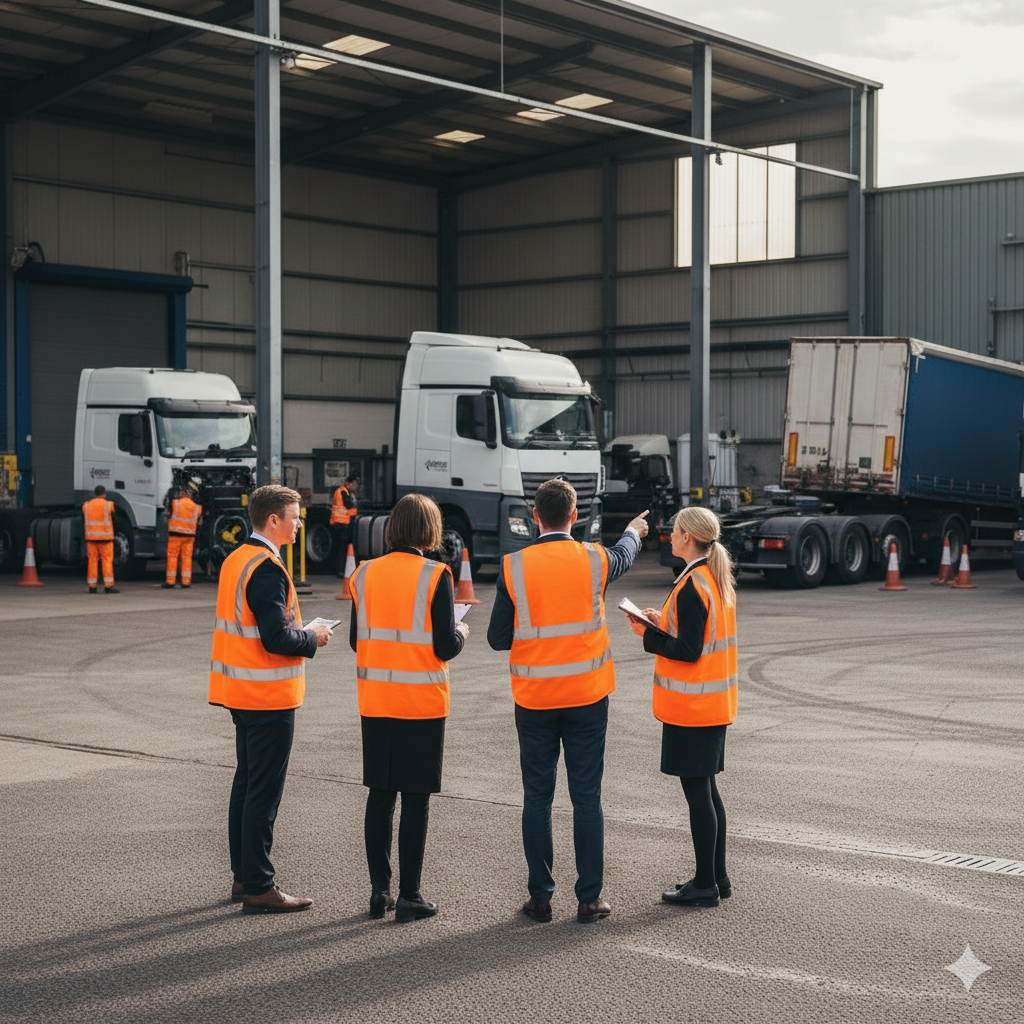
So let’s talk, plainly and usefully, about what an enterprise driver training provider actually does — and how an outsourced HGV training model can help you scale training across a logistics network without turning your operation into a scheduling soap opera.
The enterprise headache: why HGV training breaks at scale
At a single-site level, you can brute-force it. Phone calls. Spreadsheet juggling. A heroic admin who lives on coffee and spite.
At multi-site level, that approach snaps. Not dramatically. Quietly. Death by a thousand “quick questions.”
What usually breaks first:
- Multi-site complexity
- Shift patterns that don’t match reality on paper
- Peak periods where “training days” become fantasy
- Local test availability changing the timeline
- When providers and standards vary, so do the results. Pass rates can range from 35% to 60%, showing how such irregularities add hidden costs for your fleet. Delivery delays make things worse, causing more interferences and inefficiencies.
- Compliance risk
- CPC deadlines creeping up like fog
- Proof of competence scattered across inboxes
- Audit trails that look… imaginative
- Renewals are missed because nobody owns the whole picture
- Operational risk
- Driver shortages you feel in your ribs (Continued fall in HGV drivers puts ‘industry at crossroads’, warns Logistics UK, 2025)
- Contract mobilisation deadlines (new depots, new clients, new headaches)
- Seasonal surges where you need trained capacity yesterday
And yes, even if you’ve done this for years, Driver CPC compliance still matters, still changes, and still needs to be tracked. If you depend on drivers, you need to keep everything working well.
What an “enterprise driver training provider” actually is (plain English)
An enterprise driver training provider isn’t a place you send someone for “a few lessons.”
It’s a partner that runs the training operation across your sites – end-to-end, so the output is consistent, measurable, and not dependent on which depot manager is best mates with which local school.
In other words: they don’t just deliver training… they deliver training throughput.
What “enterprise-grade” usually includes:
- National coverage with a scalable trainer/provider network
- Central programme management (one plan, many depots)
- Standardised training pathways
- Cat C
- Cat C+E
- CPC modules/compliance training
- Reporting + governance
- Visibility by depot / region / candidate
- Pass rates, timelines, blockers, proceeding steps
- A managed process so you’re not rebuilding the wheel at every site
If you’re looking at Insite Training specifically, the language you’ll see repeatedly is essentially: fully managed, designed to reduce hassle, built for logistics businesses with distributed teams. (Which, let’s be honest, is the real world you’re living in.)
Internal link to anchor this section:
- HGV training for business: https://insite.training/hgv-training-courses-for-business/
What outsourced HGV training is (and what it isn’t)
Let’s draw a thick line between two very different things.
Outsourced HGV training is not:
- “We’ll book your driver onto a random driving school and hope for the best.”
- “We’ll send you a quote, & you can sort the rest.”
- “We do the training bit — you do everything else.”
Outsourced HGV training is:
- A managed service that takes ownership of:
- planning
- scheduling
- communication
- delivery coordination
- evidence collection
- reporting
- and the boring-but-critical follow-through
The enterprise value is surprisingly unglamorous… but brilliant:
- Less admin load (because you’re not chasing five different providers) (Driver Academy Group helps 1,300 new HGV drivers get behind the wheel, 2025)
- Faster completions (because it’s tracked and pushed)
- Consistent standards (because it’s standardised)
- Fewer surprises (because blockers are flagged early)
- Cleaner compliance (because evidence is captured properly)
Internal link to support the concept:
- Core HGV training offering: https://insite.training/hgv-training-courses/
The typical outsourced process
Here’s how it tends to work when it’s done like an actual system — not a lucky charm.
Step 1 > Scope the need across the network (not just “how many drivers?”)
If you start with “we need 20 drivers trained,” you’ll miss the truth.
What you actually need is a network view:
- Which depots?
- Which shifts?
- Which vehicle types and operating requirements?
- New entrants vs upskilling existing staff?
- Current compliance backlog:
- CPC expiries
- licence types
- incident trends
- retraining needs
A good enterprise driver training provider will push for this explicitness early — because otherwise you’ll discover the constraints mid-flight, when it hurts.
Internal link (context, broader tactical workforce training):
- Warehouse training service offering: https://insite.training/warehouse/
Step 2 > Build role-based training pathways (what each learner must complete)
This is the step where you move from just having a plan to building a repeatable process.
A typical licence acquisition pathway (example structure):
- Medical
- Module 1 theory
- MCQ + hazard perception
- Module 2: Initial CPC theory
- case studies
- Module 3 practical
- training + tests
- Module 4 CPC practical
- training + test
- Support touchpoints
- webinars
- check-ins
- learner comms (so people don’t drift off into the ether)
You’re not just training. You’re managing attrition risk, the silent killer of “we’ll just put them through.”
Internal link:
- HGV Skills Bootcamp (if applicable): https://insite.training/hgv-skills-bootcamp/
Step 3 > Deliver nationally, consistently (the “multi-site delivery” bit)
This is the bit your brain jumps to first – but it only works smoothly if Steps 1 and 2 exist.
In a multi-depot model, delivery needs:
- UK-wide delivery capability plus scalable scheduling
- Central coordination so every depot isn’t reinventing the wheel
- A consistent standard of training outcomes (not just “bums on seats”)
If your provider can’t deliver across your footprint, you’ll end up with the dreaded hybrid monster:
- half managed centrally
- half patched locally
- 100% irritating
Heres a link to our service:
- HGV training for business: https://insite.training/hgv-training-courses-for-business/
Step 4 > Check progress and compliance in one place
Now we get to the part that makes grown managers visibly calmer.
Because what you need isn’t “updates.” You need control.
A managed model should give you things like:
- Real-time progress visibility
- Pass rates and failure points (so you can fix the pipeline)
- Action alerts (who needs what next)
- Scheduling clarity (who’s booked, who’s blocked, why)
And, ideally, learner engagement tools that reduce drop-off:
- reminders
- e-learning support
- comms that actually reach the driver
Internal links:
- Client portal (visibility + reporting): https://insite.training/client-portal/
- App (learner engagement): https://insite.training/app/
Step 5 > Governance + continuous improvement
This is where outsourcing stops being “a project” and becomes “a capability.”
The right rhythm looks like:
- Quarterly reviews by depot / region
- Bottleneck analysis:
- test availability
- failed modules
- no-shows
- scheduling clashes
- Forecasting:
- “how many drivers do we need next quarter?”
- “which depots will strain first?”
- “where do we build from within?”
You’re building an internal engine, but you’re not building it alone.
Do you know what your network’s training bottleneck is?
Here’s a simple operating model that works (because it assigns ownership cleanly):
- Central training lead (HQ / L&D / Fleet)
- sets standards
- defines throughput targets
- agrees reporting cadence
- Regional ops managers
- confirm capacity windows
- nominate candidates
- protect operational reality (the thing spreadsheets ignore)
- Site managers
- support release time
- manage local coordination
- keep the wheels turning while people are off-site
- Provider (Insite / managed partner)
- runs scheduling
- coordinates delivery
- handles comms and evidence
- produces reporting end-to-end
And a rollout plan you can copy-paste into a deck without feeling weird:
- Pilot
- 2 depots
- 8–12 candidates
- objective: prove pipeline + identify blockers
- Scale
- expand to 10 depots
- monthly intakes (predictable cadence)
- Mature
- always-on programme across 30–50 depots
- forecast-driven
- consistent governance rhythm
That’s how you stop “training” being a scramble and start it being part of workforce planning.
Don’t treat HGV training as isolated: link it to warehouse capability (the internal talent pipeline)
Here’s the slightly unfashionable truth:
The strongest fleets don’t only “recruit drivers.”
They build drivers.
Warehouse → yard → driver is a real pathway when it’s designed effectively.
Why it matters:
- You curb reliance on unpredictable external hiring spikes
- You keep culture and standards consistent
- You create progression that helps retention (because people can see a future)
And while you’re building that pipeline, warehouse training keeps operations safe and compliant — so the whole place doesn’t go wobbly while you’re developing talent.
Internal link (use as your pillar explanation of service offering):
- Warehouse training programmes: https://insite.training/warehouse/
Case studies: what scaled training looks like in the real world
No waffle. Just the pattern: challenge / approach / result.
Case study 1 – SUEZ: contract mobilisation + rapid capacity uplift
- Challenge: shortage ahead of a major contract go-live
- Approach: upskill staff via managed service + Skills Bootcamp support
- Result: 40 trained to Category C; £145,000+ saved
Internal link: https://insite.training/case-study/suez/
Case study 2 – Metro Rod: nationwide network needs training without disruption
- Need: ongoing upskilling while keeping daily operations moving
- Result: 14 drivers trained to Category C; £50,000+ saved
Internal link: https://insite.training/case-study/metro-rod/
Case study 3 – J. Heebink: warehouse staff → driver roles (internal progression)
- Approach: upskilling warehouse employees into driver roles via Skills Bootcamp
Internal link: https://insite.training/case-study/j-heebink/
Case study 4 – JG Pears: reducing delays caused by training bottlenecks
- Solution: managed Category C+E via subsidised bootcamp scheme
- Result: 3 employees trained; improved delivery capability
Internal link: https://insite.training/case-study/jg-pears/
And yes – the “social proof” bits matter too. The best version of this isn’t a logo soup; it’s a believable signal that enterprise teams use the platform and the process at scale.
Internal links:
Funding and cost control
Funding conversations can get… weird. People either ignore them completely or make them the whole plan.
A sensible view:
- Skills Bootcamps and similar routes can be relevant depending on eligibility and current schemes.
- Enterprises often need clear expectations on:
- contribution levels
- admin requirements
- evidence and reporting
- timelines
Where a managed provider earns their keep is not “finding magic money.” It’s handling the admin and compliance mechanics so funding doesn’t become a side-quest that collapses under paperwork.
Internal link:
How to choose an enterprise driver training provider
If you’re assessing providers, print this (or, fine, screenshot it like the rest of us).
- National / multi-site delivery
- Can they genuinely cover your footprint?
- End-to-end management
- medical → tests → CPC → evidence → reporting
- Audit-ready reporting
- Can you prove compliance without archaeology?
- Learner engagement
- Do they reduce drop-off with comms, app support, reminders?
- Operational fit
- Can they work with shift patterns and actual depot constraints?
- Adjacent capability
- Can they support warehouse training, forklift, first aid, etc., so you’re not juggling vendors?
Internal links:
- https://insite.training/hgv-training-courses-for-business/
- https://insite.training/client-portal/
- https://insite.training/app/
- https://insite.training/warehouse/
FAQs
Can you run large-scale, multi-site HGV training nationally?
Yes — that’s the point of an enterprise driver training provider. The model relies on central programme management with delivery that scales across depots, not a patchwork of local one-offs.
Internal link: https://insite.training/hgv-training-courses-for-business/
What does a fully managed outsourced process include?
In short: scoping, pathway design, scheduling, delivery coordination, learner comms, evidence capture, and reporting — plus governance to keep improving throughput.
How long does it take to get a new driver licensed?
It varies. Test availability, learner readiness, and release time are the big levers. A managed model improves predictability by spotting blockers early and keeping candidates moving.
How do we keep visibility across depots?
Central reporting and status tracking — ideally through a portal — so HQ and regions see the same version of reality.
Internal link: https://insite.training/client-portal/
Can we train warehouse staff into driver roles?
Yes — and it’s often the most reliable pipeline for enterprise fleets. The J. Heebink example is a clean illustration of internal progression.
Internal link: https://insite.training/case-study/j-heebink/
Closing: a simple next step
If you’re weighing outsourced driver management and training, don’t start with a massive rollout. Start with a network map and a pilot cohort.
- Map depots, shifts, and training demand
- Identify bottlenecks (tests, release time, admin, learner drop-off)
- Run a pilot across 2 depots
- Then scale with a monthly intake rhythm across the network
And if you want a practical, managed model to benchmark against, start here:
- Warehouse service setting (full offering): https://insite.training/warehouse/
- Enterprise HGV training: https://insite.training/hgv-training-courses-for-business/
Get in contact
Have an informal chat with the Insite team if you’re asking questions like:
- How quickly can an enterprise training provider be onboarded and start delivering results?
- What are the typical costs or pricing models?
- How flexible can the Insite training model be for my business?
- What support is on offer for transitioning from in-house or local training to an outsourced approach?
Call now on: 0330 818 8888